New tools at test stage
Moving from development to testing
Over the past few years, much of our work has focused on the co-design and development of new tools. This year has been particularly exciting because we are moving into the next stage. We are now testing, deploying and trialling those tools.
Mining Your Mind App
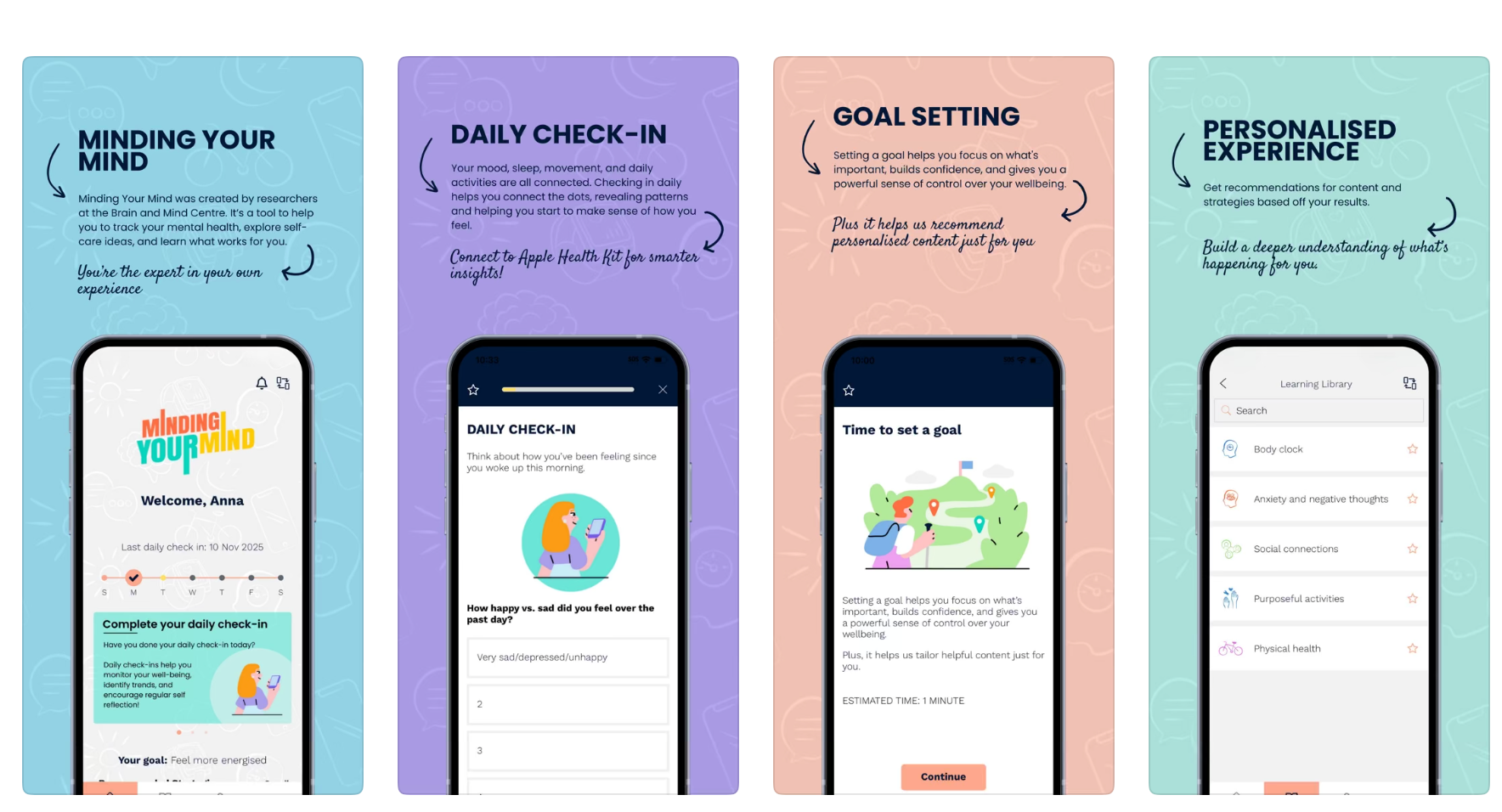
One of the tools I am most interested in is the Mining Your Mind app. It is available free on Apple and Android and provides a basic daily tracker or mood check-in. The app allows people to report on aspects of their experience each day.
These include
- mood
- anxiety
- irritability
- sleep
- activity and energy.
On its own, tracking this information is relatively straightforward. What becomes more interesting is how we can use the collected data to help people understand their own mental health.
Learning from a month of data
We are using the app as part of the CARES trial. People use it for a month and complete daily reports about their experiences. After collecting that data, we use models we have been developing to process it and identify relationships between different parts of a person’s life and health. We might examine the relationship between mood and social connection, functioning and energy, or sleep and energy. We then generate a report and provide it to the young person and their clinician. The report is intended to support shared decision-making and help guide clinical care.
Understanding individual experience
By modelling someone’s individual patterns, we can begin to identify which area of their life is most likely to have the greatest positive effect on their mood or another outcome.
That could mean understanding how social connection relates to mood, how energy affects functioning, or how sleep influences energy. The important point is that the relationship comes from the individual’s own information rather than being based only on general trends. For me, this is an important step towards much more personalised care.
Moving beyond trial and error
Clinical trials can tell us that a particular treatment tends to work for most people. That evidence may guide us towards a treatment that is likely to help, but the process can still involve considerable trial and error.
We can sometimes make care more personalised by considering what has worked for people with similar sociodemographic characteristics. Reaching the individual level, however, is much harder. Usually, we only get there by trying something, observing the response and adapting accordingly. Individual clinicians already do this intuitively. They treat people as individuals and respond to what works for each person.
Our work is trying to add a computational and technological approach to that clinical process. This could allow an individualised approach to be scaled and measured, while remaining focused on the needs and experiences of the person receiving care.
Measurement must have a purpose. I do not want us to measure something simply for the sake of having another tool or widget. All our work is about using measurement to improve care for consumers.
Ai steps up
I also see considerable potential in the way artificial intelligence could support assessment and navigation. I think this is where we are likely to see some of the biggest advances in the near future. We are already getting closer to improving how people are assessed when they first present for care and determining where in the health system they should begin.
That starting point needs to be appropriate for the individual and their needs. Assessment plays an important role because it shapes what happens next and where a person goes for support.It should not be treated as a one-off event. Assessment needs to be repeated as a person’s needs and circumstances change.
It's all in the first contact
However, the first contact remains particularly important. If we can use these developments to create a better initial assessment, guide people towards the right starting point and make their first experience of care more appropriate to their needs, I believe we will see meaningful progress over the next few years.