
A good look ?
What does “good” look like, in a response to mental health.
I recently had the privilege of spending some time in the UK talking to a range of colleagues. As often happens when I’m away, I was stimulated to reflect on the situation in Aotearoa/New Zealand. It made me aware of our many opportunities, progress and challenges. It makes me ask, ‘what are we aiming for in responding to the mental health of our nation – what would “good” look like?’
In doing this you could write volumes of detail. We need depth and expertise, but we can get lost in the weeds – it is useful to bring the focus back to the bigger picture. Often what is missing as we strive to make change is the ‘system thinking’ – we need to ask ‘how do the different elements interact, and what does each policy or service change mean for the big picture?’
This is what I have come up with as “thinking in progress”. I share it as a contribution to our collective effort to achieve positive mental health for our nation and world.
As a diagram it might look like this:
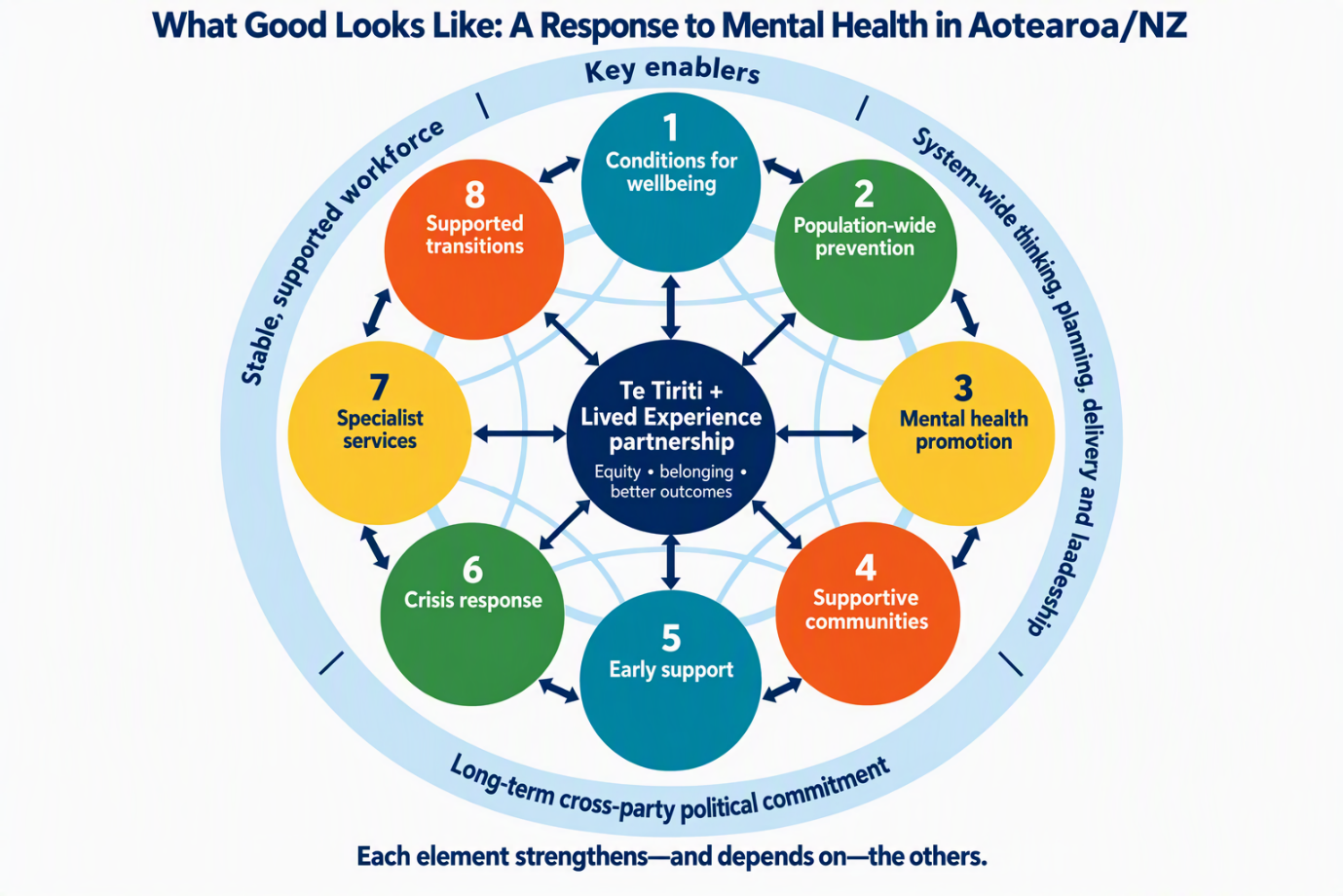
Key enablers and themes explained:
Te Tiriti partnership and lived Experience co-design - Colonisation has been devastating for Māori mental health. We can’t ‘treat’ our way out of that reality. Only Te Tiriti partnership at all levels can create the equity to address this harm.
Nothing will change in a meaningful way unless people with lived experience – those with the most to gain from change – have power in the decision-making process.
A stable, supported workforce – To build service cultures around compassion, human rights, cultural responsiveness and skill, we need diverse people to be attracted to the field, to be mentored and trained, and to enjoy their experience so that they stay. We need minimal turnover, which means staff need to be well supported in every way. Without this every service aspiration falls apart.
System-wide thinking, planning, delivery and leadership – The full picture of ‘what good looks like’ needs to be firmly in everyone’s mind as specific decisions are made. For too long the view of mental health has been service centric, paying minimal attention to public health including the social and economic drivers of distress, to prevention, and to health promotion. Yet we all know services alone are not enough – if they were, we wouldn’t be seeing a doubling of prevalence in the whole population in five years, with young people in distress rising from 11% to nearly 23%!
Mental health is not a health issue – it’s a social, economic and life circumstance issue. It’s impacted by employment, housing, education, racism, discrimination, violence, climate change, technology and hope for the future. Mental health is about the conditions we live our lives in, things that happen to us, and the resources and support we have to deal with them.
Decision-makers need to take all of this into account. They must not only ask, ‘how does this decision impact the other parts of the service system?’ but also, ‘how can we take the whole response to the mental health of our nation forward in a co-ordinated way?’
Long-term cross-party political commitment – creating positive mental health for Aotearoa New Zealand is a long-term investment. But failing to act is a short road to catastrophe – what sort of life do we want an18 year old in mental distress to have in three years, five years, 10 years’ time? What contribution do we want them to be making to our economy and community?
If we want that future to be “good” we need thinking that doesn’t expect pay-off in a three-year election cycle. This requires political parties to reach some consensus about the way forward. There are signs of hope in things like the Cross-Party Mental Health and Addiction Wellbeing Group. More parties are also emphasising concepts of prevention and public health in health policies. We need our political leaders to address the big issues and interplay between mental health and the economic and social decisions they make. The “same old, same old” short-term siloed political and policy approach is not acceptable. It won’t do because it won’t work. Our young people and all of us deserve better.
To me, the package I’ve outlined of “what good looks like” is what we should be striving for. Frankly, if we want to see the trend of doubling rates of people in distress turn into an upward trend of people flourishing; and if we want our economy, communities and society to thrive – this is what we have to do.