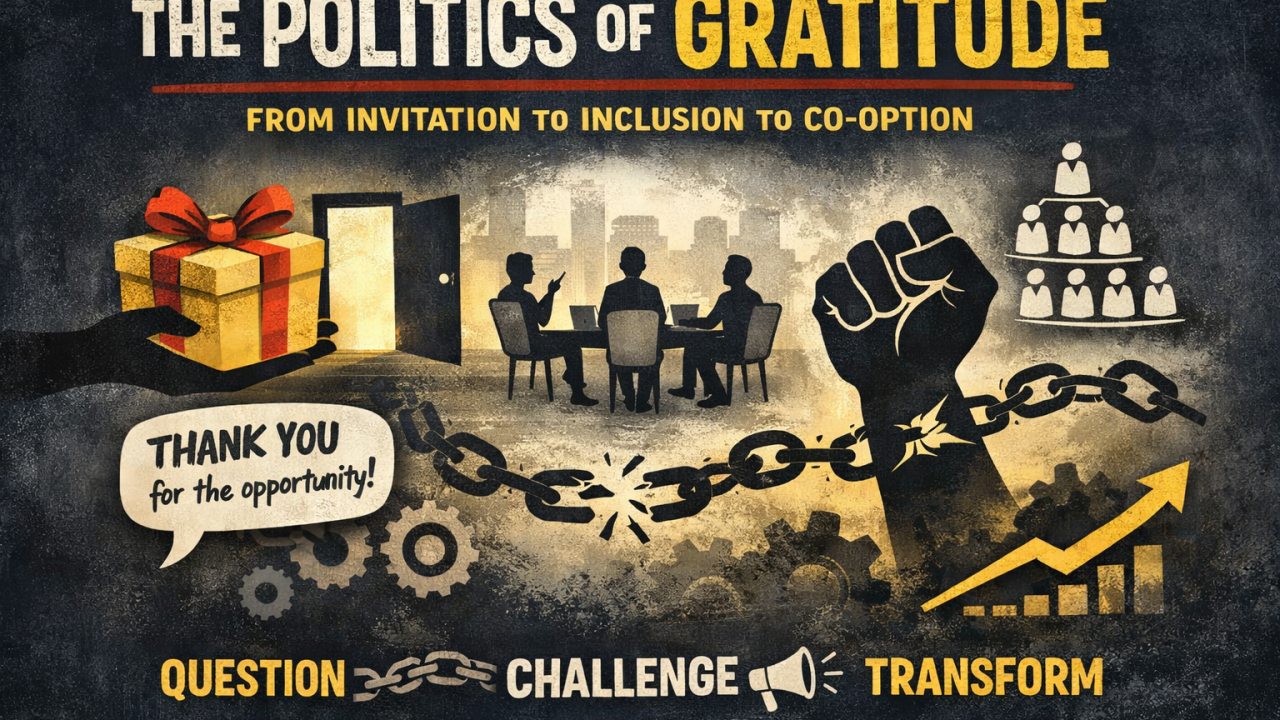
The politics of gratitude
When invitation is framed as a gift
In 2014, I learnt something I have carried with me every day: there is a quiet trap many of us with lived experience have been taught to step into willingly - gratitude (and yes, I know gratitude can be a helpful wellbeing practice; this is something else).
Grateful to be invited. Grateful to be consulted. Grateful to be “given a voice.” Grateful to sit in rooms where decisions are already half-made.
This, too, is by design.
Systems do not reform through goodwill. They reform when the default changes: when our participation is assumed, not applauded; when we are no longer guests in spaces shaped by our exclusion; when our authority is embedded, resourced, and real.
Yet many of us - especially those shaped by psychiatry, poverty, disability, trauma, and marginalisation - have been taught to act like polite guests. To say thank you (even for crumbs). To smile when the door opens a fraction.
And something dangerous happens there.
True belonging is not by invitation
The Emotional Labour of Being “Allowed In”
There is a cost to being “included” - an emotional labour that often goes unnamed. We are praised when we turn pain into pedagogy, when we translate harm into learning, when we make the unspeakable digestible. We are relational even as we are marginalised and still expected to be grateful.
Thank you for listening. Thank you for having me. Thank you for valuing my voice.
Even when what’s occurring is extraction: of knowledge, legitimacy, authenticity. And, this labour is rarely resourced or reciprocated. And if we resist, if we show fatigue, anger, or refusal, we become “difficult,” “unsafe,” “too much.”
Respectability Politics in Lived Experience Spaces
I worry that respectability has become our silent contract. Peer workers are welcomed into teams when they soothe, not when they confront. Lived Experience Leaders are embraced when they are calm, articulate, and containable. And we are tolerated when we convert harm into lessons and rage into reflection.
But we are less welcome when we name violence (often playing out as micro-agressions) plainly; when we question legitimacy, not just process; when we refuse to dress pain in policy-friendly language.
Respectability politics teaches us that survival must be palatable to be believable. But that moderation protects institutions, not people. Not all stories are welcome - only the ones that leave power intact.
This isn’t representation. This is filtration.
From Inclusion to Co-option
Lived experience is everywhere now - in strategies, statements, and photo ops. There is a performance of progress, a glow of inclusion. And yet the power remains where it always was. Hierarchies unchanged. Risk still feared. Control still centralised.
And, I will say what I have said before - this is co-option: when radical knowledge is rehearsed, not realised; when systems absorb our language while rejecting our logic. We are asked to bring a lens, but never to adjust the focus. To share insight, not authority. To participate, not govern. And in the process - what is deemed to be inclusion becomes containment.
The Cost of Being Grateful
Gratitude on our part holds this machinery together.
It tells us not to ask for more. Not to name harm too overtly. Not to demand power too loudly (and without gratitude). Gratitude reframes justice as generosity and rights as favours. It trains us to thank people for what should already be ours.
Gratitude is not neutral. It is political. It maps power with precision, showing who must be thankful, and to whom.
Toward a Different Frame
What would it mean to stop being grateful? To stop calling access “opportunity”? To stop treating participation as privilege?
What if shared decision-making were a baseline of legitimacy, not a reward for patience?
This is not a call to abandon relationality, but to deepen it. Real relationships do not require quiet compliance. They require honesty, accountability, and friction - the fertile kind that produces change. Real change should not feel comfortable.
Perhaps the most radical thing we can do is stop thanking systems. Stop being honoured by or grateful for what should already be the norm. Stop mistaking visibility for power.
And it deserves more than our gratitude to the system for (too slowly) catching up.